First webinar on supercharging innovation with LLMs & No-Code Tools

On June 12, 2025, the EVOLVE2CARE project successfully kicked off the first session of its Training Series for HealthTech Innovators and Researchers titled “From Users to Market – Faster Validation and Commercialisation for HealthTech Innovators and Researchers”, introducing participants to cutting-edge strategies for accelerating innovation through Large Language Models (LLMs) and No-Code platforms for rapid prototyping.

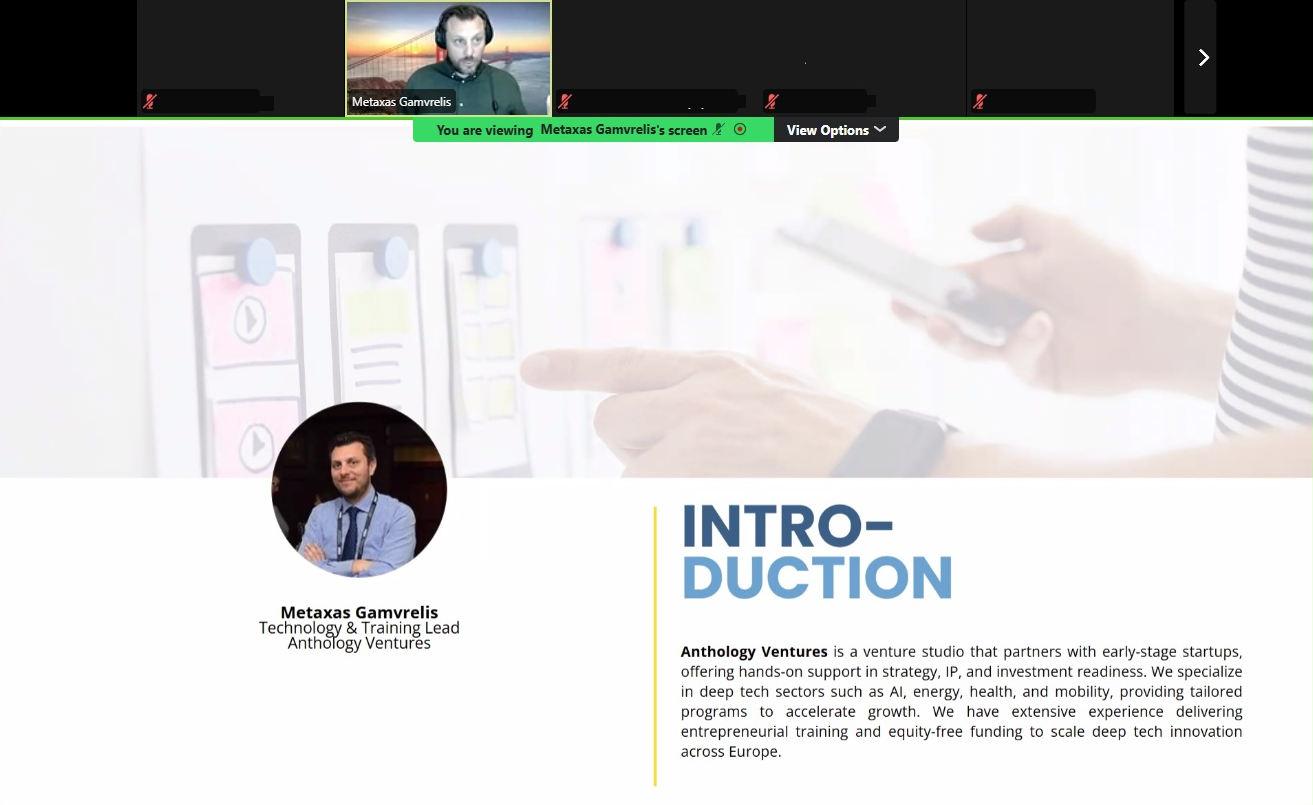
Led by Metaxas Gamvrelis, Technical & Training Lead at Anthology Ventures, the session “Accelerating Innovation — Leveraging LLMs & No-Code for Rapid Prototyping” brought together over 15 healthcare innovators and researchers, and offered a practical and inspiring deep dive into how tools and No-Code platforms like ChatGPT, Landbot, Lovable, and Google Gemini can dramatically shorten the innovation lifecycle—from early ideation to real-world deployment.

Rethinking prototyping: From weeks to days

Metaxas Gamvrelis opened the session by contrasting the traditional approach to prototyping—often slow, costly, and resource-intensive—with today’s possibilities enabled by AI and automation. He introduced a streamlined 4-stage framework that demonstrated how LLMs and No-Code tools transform each step:
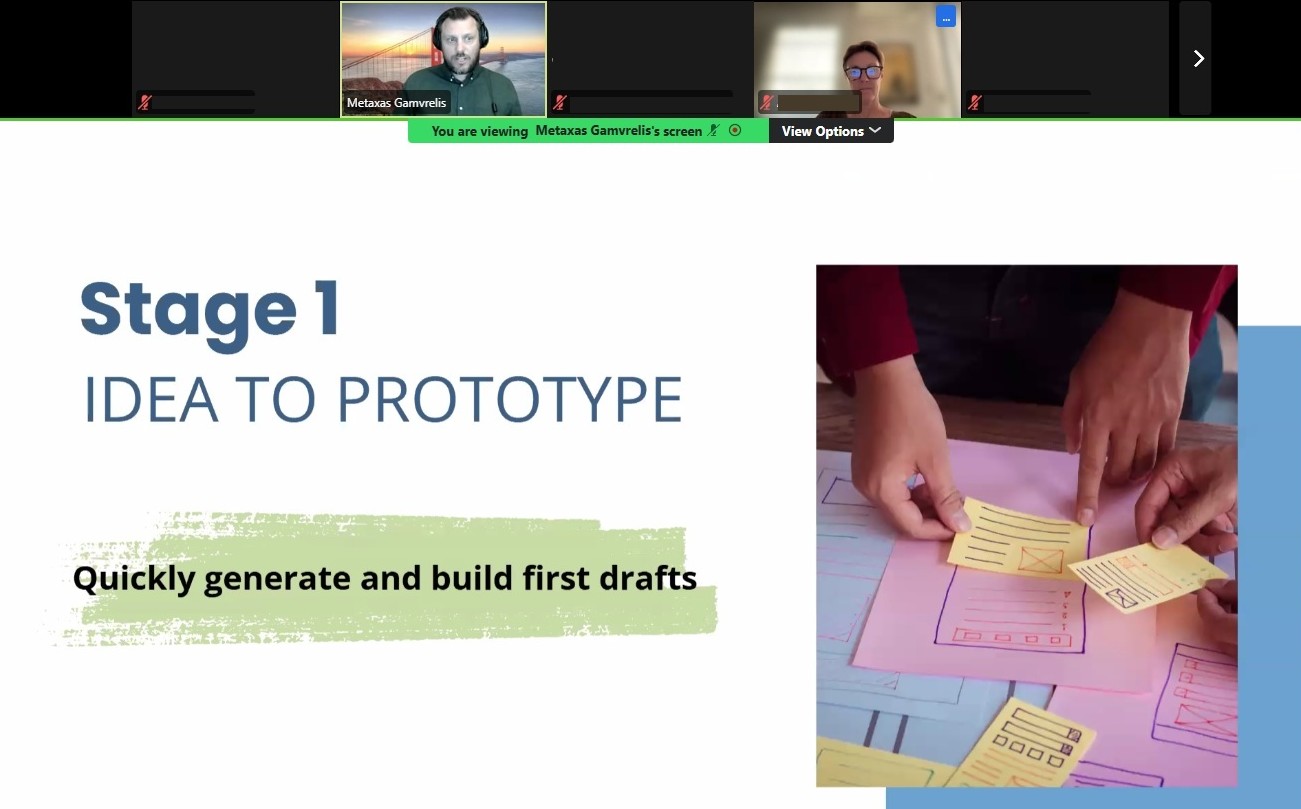
Stage 1: Idea to Prototype

AI-LLMs can accelerate product ideation and planning by:

  • Brainstorming product features and user stories
  • Drafting Product Requirement Documents (PRDs)
  • Generating user personas & customer journey maps
  • Summarizing market research

Stage 2: User testing

Feedback is fuel for innovation. With AI-powered support, innovators can:

  • Set up user tests quickly and with minimal resources
  • Gather diverse feedback from surveys, interviews, and chatbots
  • Perform initial analysis of results to identify key insights fast
  • Perform sentiment analysis and theme extraction

Stage 3: Iterate & Improve

Once initial feedback is collected, the real power of LLMs and No-Code tools emerges, enabling rapid iteration, continuous refinement, and smarter decision-making without starting from scratch.

  • LLMs help extract insights from user feedback, generate improvement suggestions, and update designs/requirements in real time.
  • Tools like Lovable and Figma support versioning and A/B testing, making iteration cycles faster, smarter, and more agile.

Stage 4: Deploy Rollout (MVP)

With minimal development time, MVPs can be launched using No-Code platforms such as Glide, Replit, and Retool.

LLMs assist by:

  • Generating product documentation
  • Drafting marketing copy, landing pages, FAQs
  • Creating onboarding flows (emails, chatbot scripts)
  • Even code snippets for future integrations

Living Labs reimagined: More agile than ever

In the next part of the session, the training and technical expert explored how this tech revolution aligns perfectly with the Living Lab methodology, a cornerstone of EVOLVE2CARE project. By combining co-creation, iteration, and real-life user involvement with the agility of LLMs and No-Code:

  • Prototypes can be created on-demand during co-design sprints
  • Feedback can be gathered in real-time through smart forms and bots
  • Iteration becomes virtually limitless within project timelines

“Living Labs are a huge gift,” he said, “because they help people check services before they’re fully developed. And now, they can do it faster, with less risk.”

To close the session, Metaxas Gamvrelis walked participants through real-time examples of how he uses ChatGPT in his own workflow. He emphasized the value of clear, well-structured prompts and shared one of his go-to techniques: “At the end of each prompt, I always ask: ‘Do you understand the task?’—it’s a small step that ensures accuracy. 

What’s next?

This first session set the tone for EVOLVE2CARE’s Training Series—equipping HealthTech innovators and researchers with practical tools to accelerate early-stage development using LLMs and No-Code platforms. The second session, “Design Thinking in Action — A Living Lab Approach to Healthtech Innovation,” is scheduled for Thursday, 19 June 2025 at 15:00 CEST.

Join us as we dive into the power of design thinking in real-life healthcare contexts. Led by Ioannis Poultourtzidis, Coordinator of the ThessAHALL Living Lab, the session will explore how co-creation, inclusivity, and user-centered design lead to more relevant, ethical, and effective innovations.

Training programs to support Innovators & Living Labs

Building on EVOLVE2CARE’s ongoing commitment to fostering collaboration between innovators and Living Labs, we are excited to announce the launch of two tailored training programs. The former program targets HealthTech innovators and researchers, equipping them with the necessary tools and knowledge to successfully commercialize their research and bring innovations to market. The latter is specifically designed for Living Labs, aiming to enhance their capacity to support innovators and strengthen their role in the development and testing of HealthTech solutions.

As the Open Call is actively inviting HealthTech innovators and Living Labs to collaborate on innovative solutions for Transitional Care (Task 2.2 – LLs, Innovators, and Researchers Scouting and Selection), EVOLVE2CARE is taking the next step by offering educational support. Through Task 2.3 – Training Program for Living Labs and Task 2.4 – Training Program for Innovators and Researchers, we are ensuring that both innovators and Living Labs are well-prepared for successful collaboration.

Training Program for Innovators and Researchers (T2.4)

This six-part Training Program, named “From Users to Market – Faster Validation and Commercialisation for HealthTech Innovators and Researchers” and leb by Anthology Ventures, will give innovators and researchers the tools, skills, and mindset needed to navigate the complex journey from lab to market.

Each session builds practical know-how in agile innovation, systems thinking, and stakeholder collaboration—while real startup founders share insights on fundraising and commercialization. Whether you’re prototyping, pitching, or scaling, this program guides your journey to real-world impact.

This program is ideal for researchers, early-stage innovators, and knowledge transfer professionals seeking to accelerate the journey from health tech research to real-world impact.

1️⃣Accelerating Innovation — Leveraging LLMs & No-Code for Rapid Prototyping | 12 June, 2025 | ️15:00 CEST

Description: This session explores how large language models (LLMs) and No-Code platforms are revolutionizing early-stage innovation. Participants will learn how to quickly transform ideas into interactive prototypes, generate user personas, draft product requirements, and create testable concepts without writing a single line of code.

2️⃣Design Thinking in Action — A Living Lab Approach to Healthtech Innovation |19 June, 2025 | 15:00 CEST

Description: This session explores how large language models (LLMs) and No-Code platforms are revolutionizing early-stage innovation. Participants will learn how to quickly transform ideas into interactive prototypes, generate user personas, draft product requirements, and create testable concepts without writing a single line of code.

3️⃣Building a Sustainable HealthTech Business — A Founder’s Journey | 17 July, 2025 | ️ 15:00 CEST

Description: In this session, participants will hear directly from a founder who turned a bold idea into a validated, mission-driven business. This session goes beyond theory to offer an honest look at the business model decisions, revenue hurdles, cost surprises, and strategic pivots that shaped their journey.

4️⃣Unlocking IP Value — Protection, Collaboration & AI Innovations | 24 July, 2025 |15:00 CEST

Description: This session breaks down the core types of IP (patents, copyrights, trademarks, trade secrets) with a special focus on HealthTech and AI-driven innovation. Participants will learn how to identify what aspects of their product are protectable, how to avoid common pitfalls, and how to turn their IP strategy into a competitive advantage.

5️⃣Fundraising & Pitching Strategies — An Investor’s Guide for Innovators | 4 September, 2025 | 15:00 CEST

Description: In this session, a managing partner from Anthology Ventures will walk the participants through how to build a funding strategy that aligns with their goals, stage of development, and long-term vision. They will learn how to identify which investor types—angel, VC, corporate, or impact—are right for them, and how to approach them with clarity and confidence.

6️⃣Measuring Impact & Scaling Pilots — Driving Evidence-Based Growth in Living Labs | 19 September, 2025 | 15:00 CEST

Description: In this final session, we explore how innovators can measure meaningful outcomes, not just outputs, and use data to drive sustainable growth. Participants will learn how to define success through SMART metrics, design robust pilot evaluations, and generate the evidence that funders, policymakers, and partners look for.

EVOLVE2CARE encourages all interested stakeholders to take advantage of these opportunities to enhance collaboration and strengthen innovation in the healthcare sector.

Training Program for Living Labs (Task 2.3)

This six-part training program, named “Trainings on Service Design for Living Labs” and led by European Network of Living Labs (ENoLL), will provide participants with the tools and knowledge to support innovators in evaluating experimental outcomes and commercializing research effectively.

By adopting a structured, service design-based approach, you will learn to develop sustainable services, navigate legal and ethical challenges, and enhance stakeholder engagement. Ultimately, this will ensure a smoother transition from research to the market.

These sessions are designed for Living Lab managers and coordinators, researchers, innovators, teams establishing new Living Labs, technology transfer professionals, and policymakers involved in innovation ecosystems.

Topics per session:

1️⃣ The Role of Living Labs in the Innovation Ecosystem | June 25, 2025 |15:00 CEST

Description: This session provides an overview of the current innovation ecosystem and examines the strategic role of Living Labs in driving open innovation. It will highlight Living Labs’ contribution to societal and economic growth.

2️⃣ Designing Tailored Living Lab Services for Innovators | July 9, 2025 | 15:00 CEST

Description: This session introduces service design and explores the process of creating tailored services within Living Labs to effectively support innovators and their specific needs.

3️⃣ Navigating Legal, Ethical & Regulatory Frameworks | August 27, 2025 | 15:00 CEST

Description: This session approaches the ethical, legal and regulatory frameworks, explores the sector-specific compliance and engages with regulatory bodies.

4️⃣ Building Innovation Networks: Communication and Engagement | September 3, 2025 | 15:00 CEST

Description: This session focuses on the importance of building strong innovation networks and effective stakeholder engagement within Living Labs. Participants will learn how to engage stakeholders in service design, with a particular focus on the AccelUp platform.

5️⃣ Certification & Standardization of Living Labs | September 10, 2025 | 15:00 CEST

Description: This session explores the essential requirements for a Living Lab to achieve certification. Participants will learn about the benefits of certification, and international recognition.

6️⃣ Measuring Impact & Evaluating Success | September 24, 2025 | 15:00 CEST
Description: This session focuses on identifying key performance indicators (KPIs) to track the performance of Living Lab services. Participants will explore methods to evaluate service design and measure its impact and performance.

EVOLVE2CARE at Cluj Innovation Days 2025

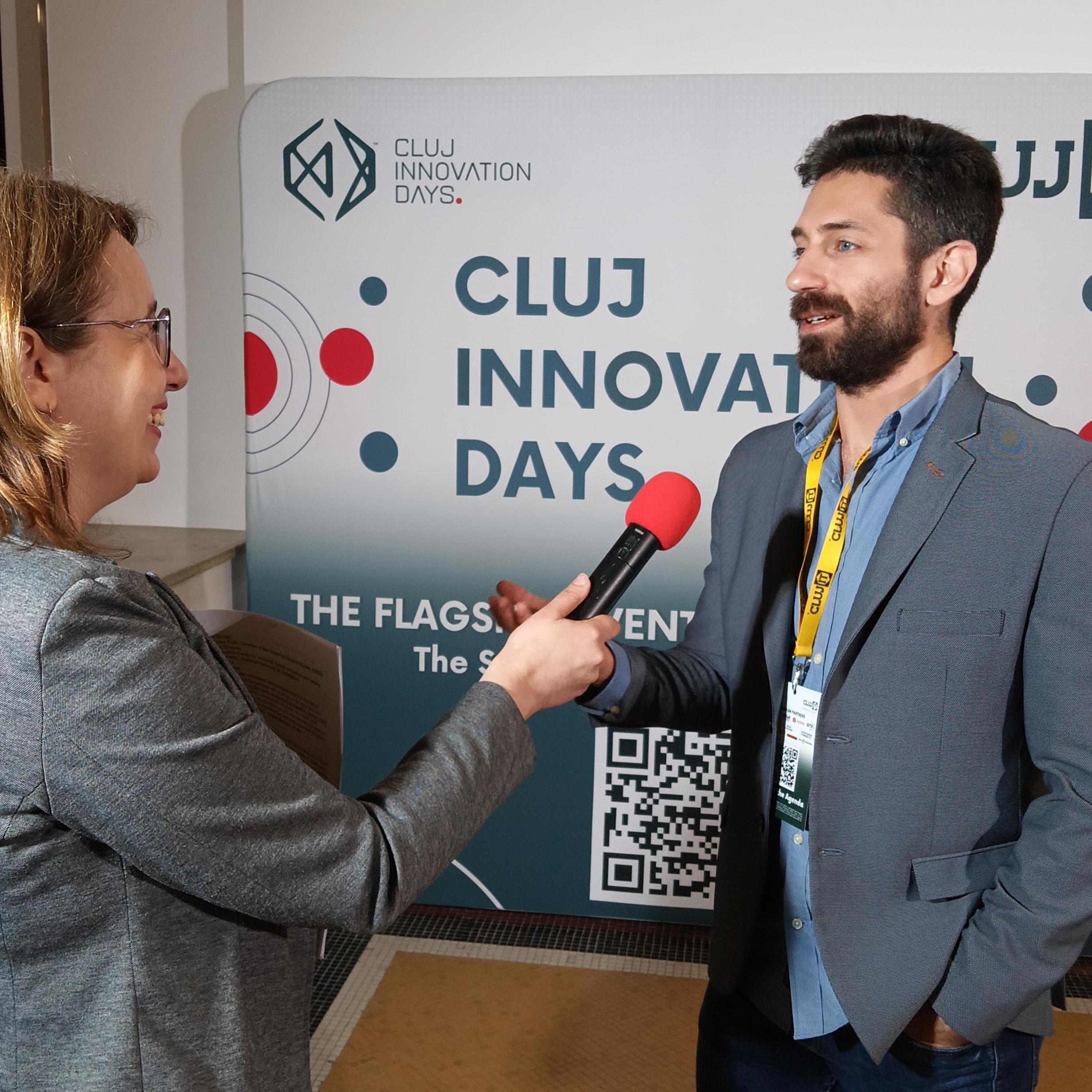
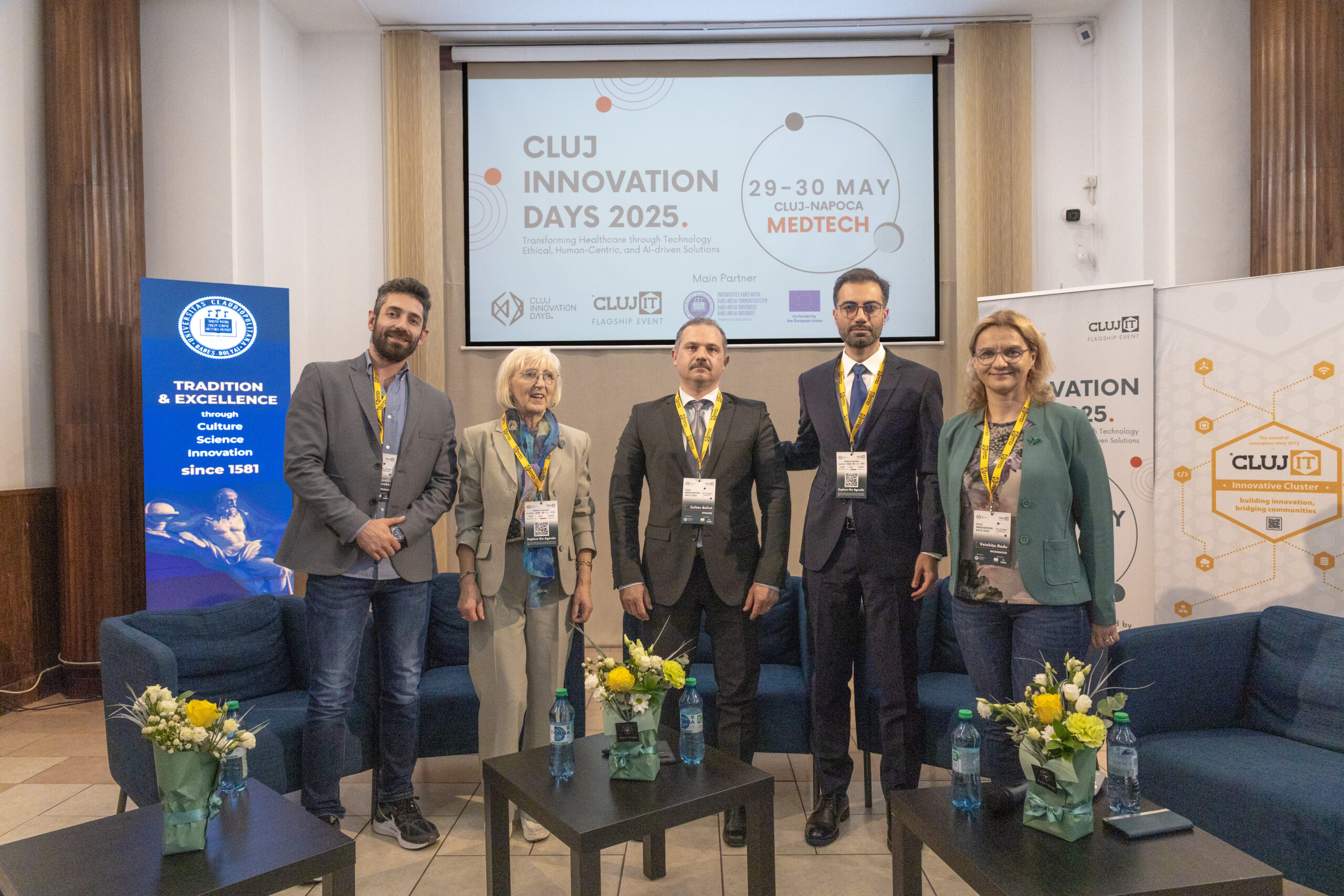
On May 29, 2025, Vassilis Voulgarakis from ViLabs represented the EVOLVE2CARE project at Cluj Innovation Days 2025, held at Babeș-Bolyai University (BBU) in Cluj-Napoca, Romania. This flagship annual event, under the theme “Transforming Healthcare through Technology: Ethical, Human-Centric, and AI-Driven Solutions,” focused on digital transformation in the MedTech sector.

As a speaker in the panel “Bridging Research, Technology, and Healthcare,” Vassilis discussed the importance of interdisciplinary collaboration in creating patient-centric, tech-enabled healthcare solutions. In addition to his speech, Vassilis gave an interview to local media, to explain how EVOLVE2CARE is looking to foster new collaboration opportunities for HealthTech innovation across Europe, bringing together researchers, startups, and innovators with Living Labs.

Vassilis also engaged in seven targeted B2B matchmaking meetings, where he presented the EVOLVE2CARE Open Call opportunity to startups and innovators. The matchmaking sessions, also, provided a platform to meet with startups, innovators, and fellow project managers, discussing potential synergies and knowledge exchange opportunities relevant to our project’s objective.

EVOLVE2CARE x GILL: Expanding our gender-informed policy

Following our insightful mini-webinar in March 2025, EVOLVE2CARE is excited to highlight the next phase of the collaboration with the GILL – Gendered Innovation Living Labs, a Horizon Europe project. This time, we extended our efforts to the entire GILL consortium during their 5th consortium meeting, held on May 22, 2025.

This in-person meeting, focused on the final stages of the GILL project and its overall impact, allowed EVOLVE2CARE, represented by Konstantina Tsimpita from AUTH Medical Physics & Digital Innovation Lab, to join forces with GILL’s gender innovation experts in advancing a comprehensive Key Performance Indicators (KPI) framework to support gender-responsive innovation in healthcare, entrepreneurship, and innovation ecosystems.

A central topic of discussion was the expansion of the societal key indicators framework, focusing on key axes such as:

  • Gender-balanced participation
  • Inclusive co-creation and decision-making
  • Gender-aware design of solutions
  • Gender-sensitive impact evaluation

These KPIs aim to embed gender perspectives throughout the innovation lifecycle and healthcare development, helping to ensure that outcomes are not only effective but also equitable and socially responsive.

EVOLVE2CARE at ELEVIT2025 in Athens

On May 23, 2025, EVOLVE2CARE participated in a dynamic session at the joint scientific event organized by ELEVIT and ELENEPY as part of ELEVIT2025 & the 2nd Panhellenic Conference of Physical Sciences in Health, held at the Wyndham Grand Athens, offering a stunning view of the Acropolis.

The panel titled “The Role of AI and Multivariate Data in Enhancing Transitional Care” was chaired by Evdokimos Konstantinidis, Project Coordinator of EVOLVE2CARE, and Despoina Petsani, a key member of the project coordination team (AUTH Medical Physics & Digital Innovation Lab). This session, held in synergy with the RAISE, DataPACT, and EVOLVE2CARE Horizon Europe projects, features OpenAIRE (a non-profit organization funded by Horizon 2020 to ensure a permanent open scholarly communication infrastructure to support European research). The panel discussion provided valuable insights into how AI and multivariate data can enhance decision-making, address challenges like data storage, access, and interoperability, and improve care quality in Transitional Care settings. 

Panel talks included:

  • Evdokimos Konstantinidis: “From Sharing to Access: Leveraging Secondary Data in Transitional Care”
  • Despoina Petsani: “Living Labs as a Catalyst for Data Collection in Transitional Care”
  • Natalia Manola (OpenAIRE AMKE) – “Open Science, AI, and Data Interoperability: Unlocking the Potential of Multivariate Data in Healthcare”
  • Olga Galanets (International Data Spaces Association) – European Health Data Space: Legislative Framework 

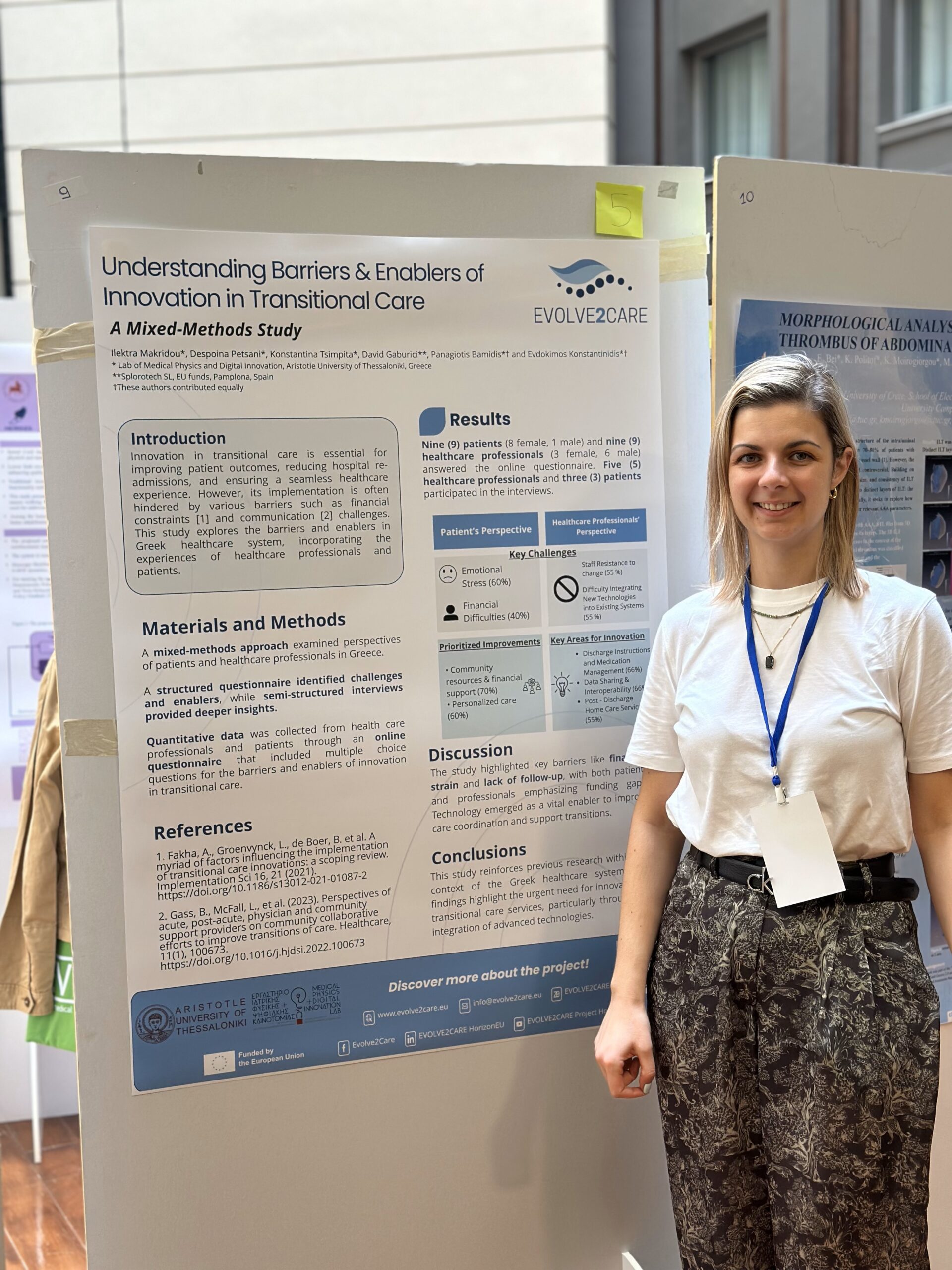
In addition to the panel, EVOLVE2CARE submitted a study titled “Understanding Barriers and Enablers of Innovation in Transitional Care: A Mixed-Methods Study” for consideration by the Award Committee. Authored by Ilektra Makridou, Despoina Petsani, Konstantina Tsimpita, David Gaburici, Panagiotis Bamidis, and Evdokimos Konstantinidis.

The study identified barriers such as financial strain and lack of follow-up, along with enablers of innovation in Transitional Care. It sparked discussions on the need for digital solutions to improve care coordination and support transitions. The study’s insights align with the EVOLVE2CARE KPI framework, particularly Task 1.1 (Drivers and Barriers for Innovation Development) and Task 1.2 (Definition of Stakeholders’ Requirements and KPI Framework). In addition, the study was showcased through a poster presentation, providing further visibility and validation of the project’s approach to key challenges in the field.

The event further solidified EVOLVE2CARE’s leadership role in advancing healthcare policy and collaboration across Europe’s digital health ecosystem, fostering synergies with fellow projects and encouraging dialogue between healthcare stakeholders.

EVOLVE2CARE at ICIC25 in Lisbon

On Friday, 16 May 2025, EVOLVE2CARE was represented at the 25th International Conference on Integrated Care (ICIC25) in Lisbon, Portugal. The conference, held under the theme “Synergising Health and Care: Leveraging Integrated Care for a Sustainable Future,” brought together over 1,000 participants — including researchers, innovators, SMEs, policymakers, and end-users to explore strategies for building more cohesive and patient-centred health systems.

Despoina Petsani, from the EVOLVE2CARE project coordination team (AUTH Medical Physics & Digital Innovation Lab), presented a study titled “Transforming Transitional Care with Technology: Insights from the Greek Healthcare Landscape.” Her presentation shared findings from an exploratory mixed-methods study on the feasibility of integrating digital tools to improve care transitions in Greece.

Based on a mixed-methods study within the Greek health system, Despoina presented key findings highlighting the lack of structured post-discharge support, limited use of digital tools in discharge planning, and strong interest among professionals in improving care transitions through digital innovation.

These insights are closely aligned with the KPI framework developed within the EVOLVE2CARE project, particularly under Task 1.1. (Drivers and Barriers for the development of innovations) and Task 1.2. (Definition of Stakeholders’ requirements and KPI framework). This means that the research not only strengthens the project’s direction but also validates its relevance in addressing real-world needs across the Transitional Care ecosystem.

Overall, this event was a valuable opportunity to strengthen the project’s engagement with international healthcare communities and gave visibility to the project activities, including the Open Call, which invites innovators and Living Labs across Europe to collaborate in testing and scaling solutions that improve Transitional Care.

EVOLVE2CARE in Istanbul: Innovating Transitional Care

On May 12–13, 2025, the EVOLVE2CARE project team gathered at Başakşehir Living Lab in Istanbul, Turkey, for two days packed with strategizing the project’s next steps and engagement with stakeholders from the global network of Living Labs specialised in Healthcare!

The first day was dedicated to the project’s internal plenary meeting; not just another coordination meetup, but a valuable opportunity to gather in person, take a step back, and align on how to move forward. The second day took a different shape: EVOLVE2CARE stepped into the spotlight of the “Health & Wellbeing Living Lab Symposium 2025” as a key contributor and facilitator to the event’s agenda!

Day 1: A strategic in-person meeting with a purpose

Hosting the meeting in Istanbul served to connect the project’s internal momentum with the wider energy of the Living Lab community.

The agenda of the meeting focused on five main priorities:

  • Finalising the Open Call process that connects healthcare innovators with Living Labs, along with its promotion strategy
  • Confirming the timeline for the upcoming training programmes for both Living Labs and innovators
  • Discussing the forthcoming “EVOLVE2CARE Action Plan” deliverable
  • Outlining the feedback loop required to address regulatory aspects relevant to HealthTech experimentation
  • Preliminary planning for the final project event

Key highlights:

  • Presenting the purpose and promotion of the key performance indicator framework, based on barriers and enablers identified in Deliverable 1.1, “Roadmap on Navigating the Complexities of Enabling Innovative Technologies in Transitional Care”
  • Demonstrating the AccelUp and SPLORO platforms for application processing for the Open Call and discussing data management procedures
  • Sharing a draft version of the six training modules for Living Labs and innovators, including session structure and learning objectives
  • Showcasing communication achievements using meaningful KPIs from the website and social media channels
  • Highlighting upcoming milestones to support the Open Call and planning participation in targeted events to boost project visibility

Key decisions from the EVOLVE2CARE plenary meeting:

  • Final adjustments are being made to the Open Call procedure to ensure that the whole process, as well as the AccelUp and SPLORO platforms, are fully functional and seamless for applicants.
  • Agreement to enhance the AccelUp platform with structured fields and profiling techniques to better support the application and matchmaking procedures.
  • Core structure and timeline for the six training sessions for Living Labs and parallel programmes for innovators and researchers.
  • A new phase of communication efforts will be launched, including updated outreach materials, demo videos for both platforms, a FAQ-based social media series

Day 2: Sharing the EVOLVE2CARE vision within the HealthTech community

The next day, the EVOLVE2CARE team participated in the Health and Wellbeing Living Lab Symposium 2025, which gathered local and international stakeholders from the HealthTech sector. As part of the Symposium, the project team designed and delivered an interactive workshop titled “Unlocking HealthTech Innovation: Living Labs & Transitional Care with EVOLVE2CARE.” The session was chaired by Aristotle University of Thessaloniki (AUTH), with SPLORO and ViLabs facilitating as moderators, and included an open exchange of information with the audience — primarily Living Labs from across Europe.

The session covered:

  • The role of Living Labs in HealthTech Experimentation and Innovation
  • The structure and purpose of the EVOLVE2CARE Open Call
  • A hands-on demonstration of the AccelUp platform
  • An interactive exercise where participants paired up as “innovators” and “living labs” to simulate real-world engagement

It wasn’t just a presentation — it was a conversation. With most attendees representing Living Labs, the session created space for practical dialogue around the Open Call, the project’s vision in the Transitional Care sector, and future collaboration opportunities.

The Health and Wellbeing Living Lab Symposium 2025 was organised with the support of EVOLVE2CARE, reflecting the project’s commitment to advancing collaboration and knowledge exchange in the HealthTech field. The AUTH coordination team also participated in the event’s Best Papers Award Committees, contributing to the evaluation and recognition of innovative work presented during the Symposium.

EVOLVE2CARE left Istanbul with renewed momentum, stronger partnerships, and a shared sense of purpose for the next phase of the project!

Find us on Social Media

EVOLVE2CARE supports the Health & Wellbeing Living Lab Symposium 2025 in Istanbul

The EVOLVE2CARE project is proud to support the upcoming Health & Wellbeing Living Lab Symposium 2025, taking place on 13–14 May 2025 in Istanbul, Turkey. The event is co-organised by Basaksehir Living Lab and DEEL Academy, with the support of the ENoLL Health & Wellbeing Working Group.

Living Labs have the potential to bring a significant impact in key issues such as non-communicable diseases; following that their role in the clinical environment and medical services is of equal importance. Delving into the Living Labs in Health and Medicine under the theme of the conference “Innovating Health and Daily Life through Living Labs”, this two-day event will offer a unique opportunity to place the multi-stakeholder collaboration at the heart of innovation. The conference aims to evaluate the impact and shape the future of Living Labs, driving research and innovation in Health and Wellbeing. Additionally, it will encourage discussions on innovative approaches for engaging stakeholders, addressing ethical issues, and tackling the challenges of data management in this field.

As part of our commitment to stakeholder engagement and Open Call outreach, EVOLVE2CARE coordination team will actively contribute to the event by hosting a dedicated workshop focused on the project’s Open Call on Tuesday 13 May 2025, 11:00-11:30.

The session will provide participants with:

  • A full overview of the EVOLVE2CARE Open Call objectives and scope
  • Step-by-step guidance on the application process and evaluation criteria
  • Opportunities for direct interaction with project partners and support teams

Join us in Istanbul as we present EVOLVE2CARE’s roadmap for supporting innovation in Transitional Care—and invite HealthTech actors to become part of our ecosystem.

EVOLVE2CARE and GILL collaborate on gender-inclusive approach

On March 29, 2025 EVOLVE2CARE joined forces with the experts from the GILL – Gendered Innovation Living Labs, Horizon Europe project, for a focused mini-webinar on future collaboration and the validation of social and gender Key Performance Indicators (KPIs).

This targeted exchange brought together EVOLVE2CARE partners from AUTH Medical Physics & Digital Innovation Lab — Despoina Petsani and Konstantina Tsimpita — with GILL’s gender innovation experts to align efforts and perspectives on how to embed social responsiveness and gender inclusivity into KPI frameworks.

To clarify, the webinar explored how to structure KPIs that account for gender dynamics within innovation ecosystems. Key topics included measuring gender representation, assessing inclusivity in decision-making, and ensuring innovation addresses diverse societal needs

At EVOLVE2CARE, we are committed to strengthening collaboration between Living Labs and innovators in the context of Transitional Care — and this exchange with GILL represents a valuable step toward more inclusive, impactful outcomes, supported by AUTH’s academic expertise in advancing equitable and patient-centred healthcare solutions.

Third project workshop on regulatory requirements for medical devices in Digital Health

As part of the Online Workshop Series to Explore Innovation in Transitional Care, the third and final session brought together healthcare professionals, researchers, and innovators to tackle one of the most challenging aspects of bringing medical innovations to market: regulatory compliance. The series, organized under the framework of the EVOLVE2CARE project (learn more here), aimed to support those working at the intersection of healthcare and technology by providing actionable insights from leading experts.

In this final workshop, Mrs. Katerina Zisaki, Quality and Regulatory Director at PKNM Solutions, delivered an in-depth presentation on the regulatory pathways for medical devices and digital health solutions in Europe. Her talk shed light on the complexities of CE certification, the Medical Device Regulation (MDR), In Vitro Diagnostic Regulation (IVDR), and the upcoming Artificial Intelligence Act (AI Act), offering practical advice for researchers and startups on how to successfully navigate these processes.

Understanding the CE Certification Process

Mrs. Zisaki emphasized the importance of CE certification, which ensures that a medical product meets general safety and performance requirements under European medical device regulations. She highlighted that beyond the 27 EU member states, several other countries—including Switzerland, Turkey, and Serbia—also recognize CE-certified products, expanding market access for compliant innovations.

A key takeaway was the broad definition of medical devices under European law. These can include:

  • Instruments and implants
  • Standalone software
  • In vitro diagnostic tools
  • Digital health solutions embedded in healthcare systems

To qualify as a medical device, the product must serve a medical purpose such as diagnosis, treatment, monitoring, or rehabilitation. She also discussed the two main regulations governing these products: the Medical Device Regulation (MDR – 2017/745) and the In Vitro Diagnostic Regulation (IVDR – 2017/746).

The Regulatory Pathway for Medical Devices

The certification process involves several critical steps:

  1. Defining the Intended Use: If a product falls within the legal definition of a medical device, the regulatory pathway applies automatically.
  2. Establishing a Quality Management System (QMS): A structured QMS (typically based on ISO 13485) is mandatory for compliance.
  3. Technical Documentation: Detailed records on product design, functionality, and risk assessment are required.
  4. Notified Body Involvement: For higher-risk devices (Class IIa, IIb, and III), an external Notified Body must evaluate compliance before the product can enter the market.

Mrs. Zisaki pointed out that the AI Act, which will be fully enforced by 2026, introduces additional requirements for artificial intelligence-driven medical devices, reinforcing the need for robust validation processes.

From Lab to Market: The Innovation Roadmap

The transition from research to market-ready innovation follows a structured process, starting with early-stage technology readiness levels (TRLs):

  • TRL 4-5: Proof of concept in a laboratory setting
  • TRL 6: Design verification and initial regulatory steps
  • TRL 7-9: Clinical validation and certification for market access

One critical point she stressed was the importance of locking the design at the verification stage. Continuous modifications during the validation process can delay certification and increase costs, making early regulatory alignment essential.

Digital Health & Software as a Medical Device (SaMD)

Mrs. Zisaki elaborated on the growing role of digital health solutions, noting that most software-driven healthcare products now fall under Rule 11 of the MDR. If software influences medical decisions, it is classified as a medical device and requires compliance with MDR standards.

Key challenges for software-based medical devices include:

  • Cybersecurity & Data Privacy: Compliance with GDPR and cybersecurity standards (ISO 27001, 27701)
  • Software Lifecycle Management: Ensuring a structured software development and maintenance process
  • Clinical Validation: Demonstrating that the software meets real-world medical needs

For startups and research teams developing digital health solutions, Mrs. Zisaki emphasized the importance of working with regulatory specialists early in the development phase to avoid costly compliance roadblocks.

Overcoming Regulatory Barriers: Industry Perspectives

During the Q&A session, participants raised concerns about regulatory complexity, high certification costs, and slow approval timelines. Key insights from the discussion included:

  • Engaging regulatory experts early can prevent costly redesigns.
  • Investors are hesitant to fund startups without a clear regulatory pathway.
  • Europe’s regulatory environment differs from the U.S., with fewer fast-track approval options.

Industry expert Mr. Petros Malitas highlighted the need for more structured regulatory science education to bridge the knowledge gap between researchers and compliance experts.

Wrapping up the Workshop Series

As the final event of the Online Workshop Series to Explore Innovation in Transitional Care, this session provided participants with the tools and knowledge needed to navigate one of the most challenging aspects of healthcare innovation. Throughout the series, participants gained perspectives on fostering innovation, collaboration, and compliance across multidisciplinary teams.

Mrs. Zisaki’s keynote presentation was a powerful reminder that regulatory readiness must be part of the innovation strategy from the very beginning, not an afterthought. Success in bringing medical technologies to market depends on a clear understanding of the regulatory landscape, early planning, and collaboration between innovators, investors, and compliance experts.

The EVOLVE2CARE team thanks all participants, speakers, and contributors to this engaging workshop series and looks forward to continuing the conversation around innovation and impact in transitional care.